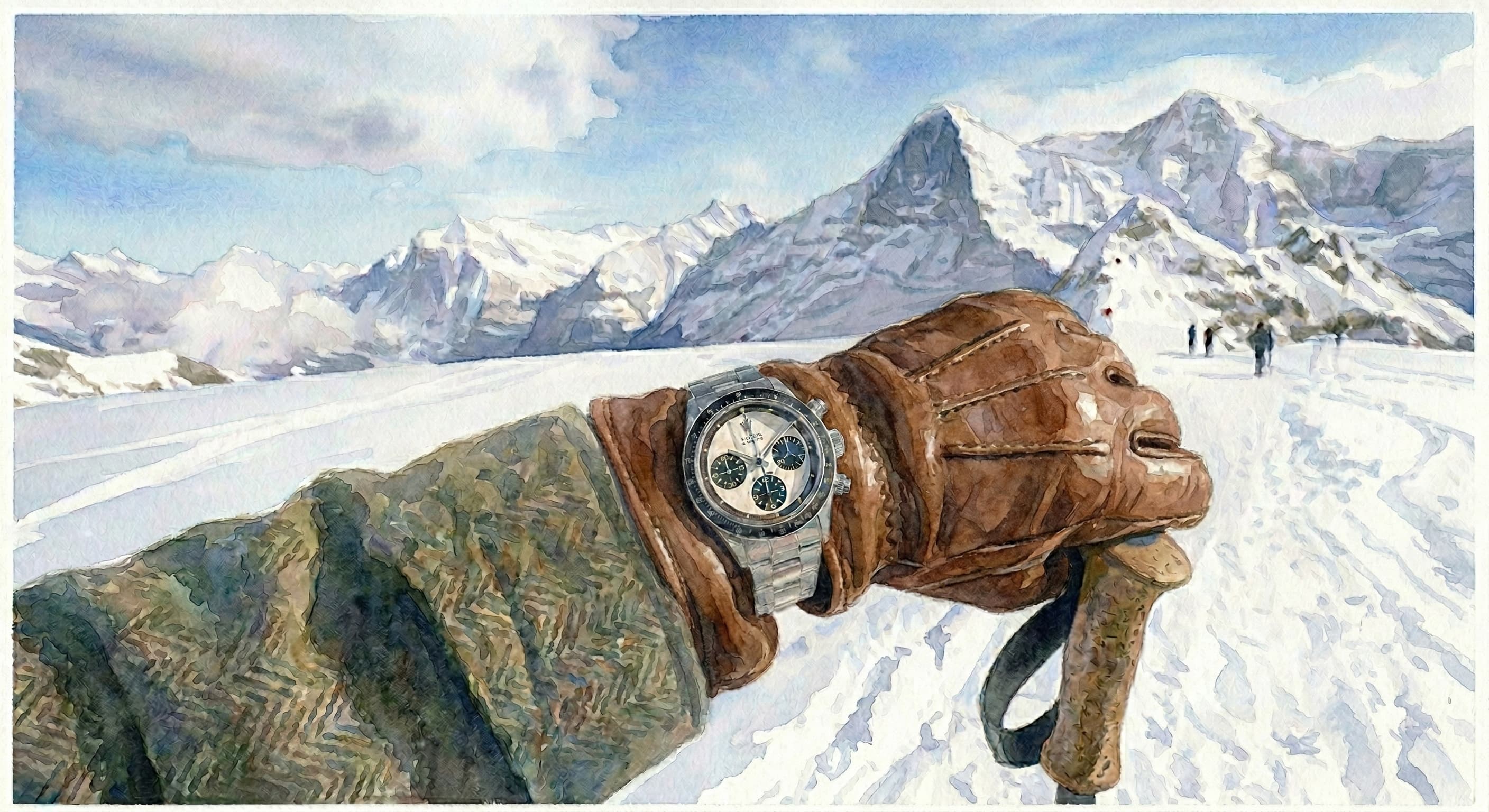
There exists a rather eccentric crossroads of obsession between my boyfriend and me: skiing and watches. If forced to choose between them, skiing would take the top spot — though ideally, our timepieces would be in synchronicity with each turn, like a well-rehearsed ballet of precision and peril.
Recently, we have found ourselves in a peculiar predicament.
We discovered a glaring void in the horological universe: no one — and I mean no one — seemed to give a damn (and honestly, why would they?) about what ticks on the wrists of those carving down mountains. We decided to investigate this chronometric conundrum.
I once heard a sage observation: “The best place in the world to ski is where you're skiing that day.” This is more than just whimsical ski-bum philosophy — the best watch? It's often the one on your wrist at that moment. A trusty companion, elevating even the most mundane of days with its mere presence. In the same way a skier paints brush strokes on an untouched blanket of fresh powder, a well-chosen timepiece adds poetry to the motion. A Cartier Tank peeking out from beneath a perfectly tailored Bogner (soon to be Chalant Society) ensemble? That's cinema.
A proper watch on the mountain is not about function. It never was. It is an act of style. A declaration. A quiet little rebellion against the tyranny of biometric data.
When I posed this burning question to my friend B, proud owner of some rather fetching Royal Oaks and Rolex GMTs, he practically committed horological heresy by admitting he just wears his Apple Watch on the slopes. Quelle horreur!
Which, of course, got me thinking.
It's not just B — this is an epidemic. Everywhere you look, the all-too-common sight of a Garmin or an Apple Watch suffocating under the sleeve of a (hopefully-not-yellow) jacket. Yes, I understand — metrics, altitude, the oddly satisfying post-ski activity rings. But here's the thing: there's an undeniable elegance to winter sports that demands proper mechanical accompaniment.
This is the horological equivalent of wearing a Patagonia over a tuxedo to a gala — which, yes, I know many in Silicon Valley do. Unfortunately. But that, my friends, is a crime in my book.
The Watches That Deserve to Be on the Slopes
The One Your Grandfather Would Approve Of
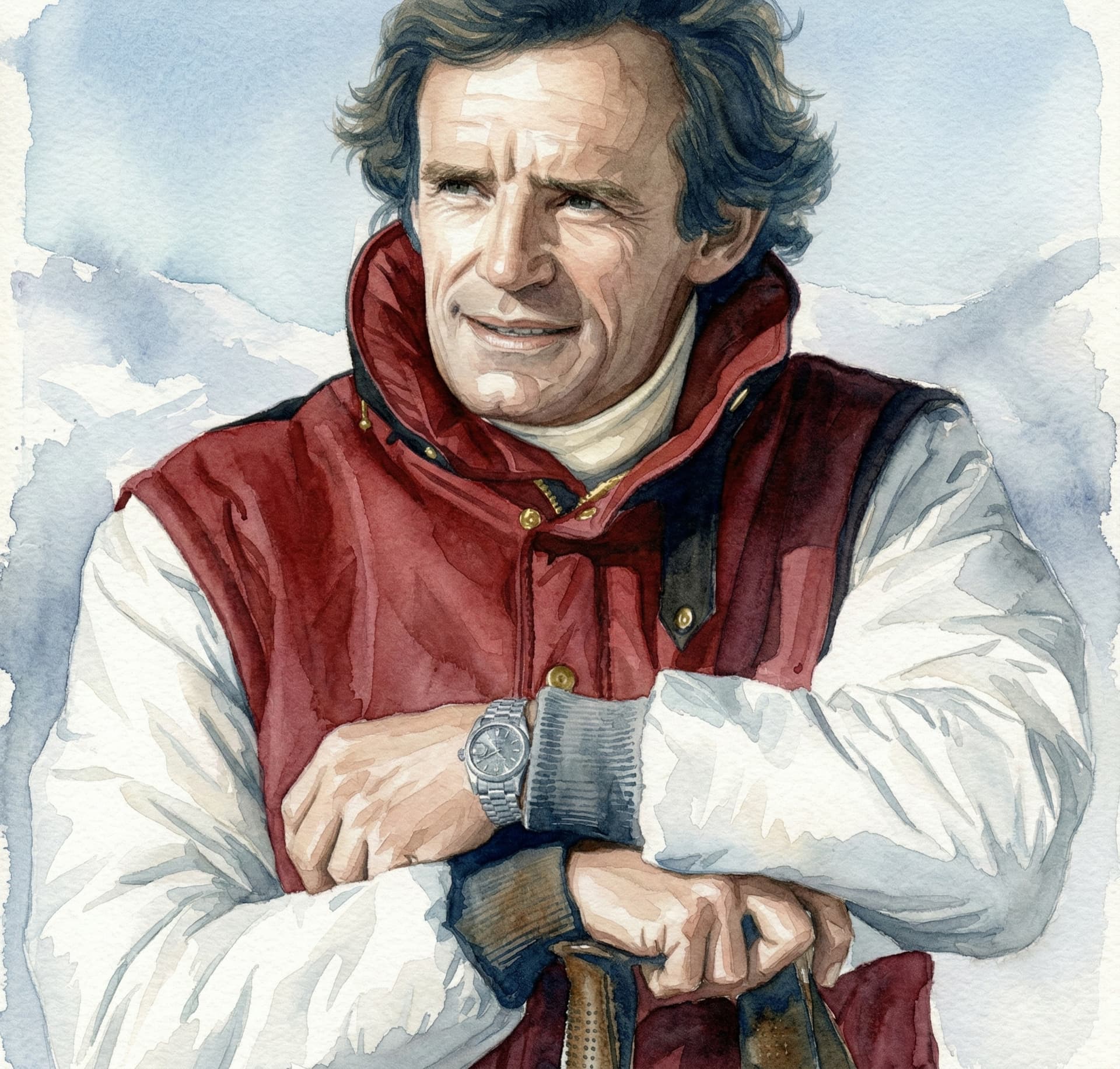
Now, as a Rolex Girl through and through, my first instinct for the perfect ski watch was the Rolex Explorer II. It's the horological equivalent of a Range Rover — technically capable, rugged, yet still perfectly at home in the landscape of mountains.
Rolex has been linked to skiing since 1968, when Jean-Claude Killy — Olympic gold medalist, and the original ski-lebrity — became the first world-class skier to don and endorse the brand. The Rolex Triple Calendar Chronograph 6236, now affectionately known as the “Killy” Rolex. A Triple Calendar for a Triple Crown skier — surely no coincidence.
The Timekeeper's Timekeeper
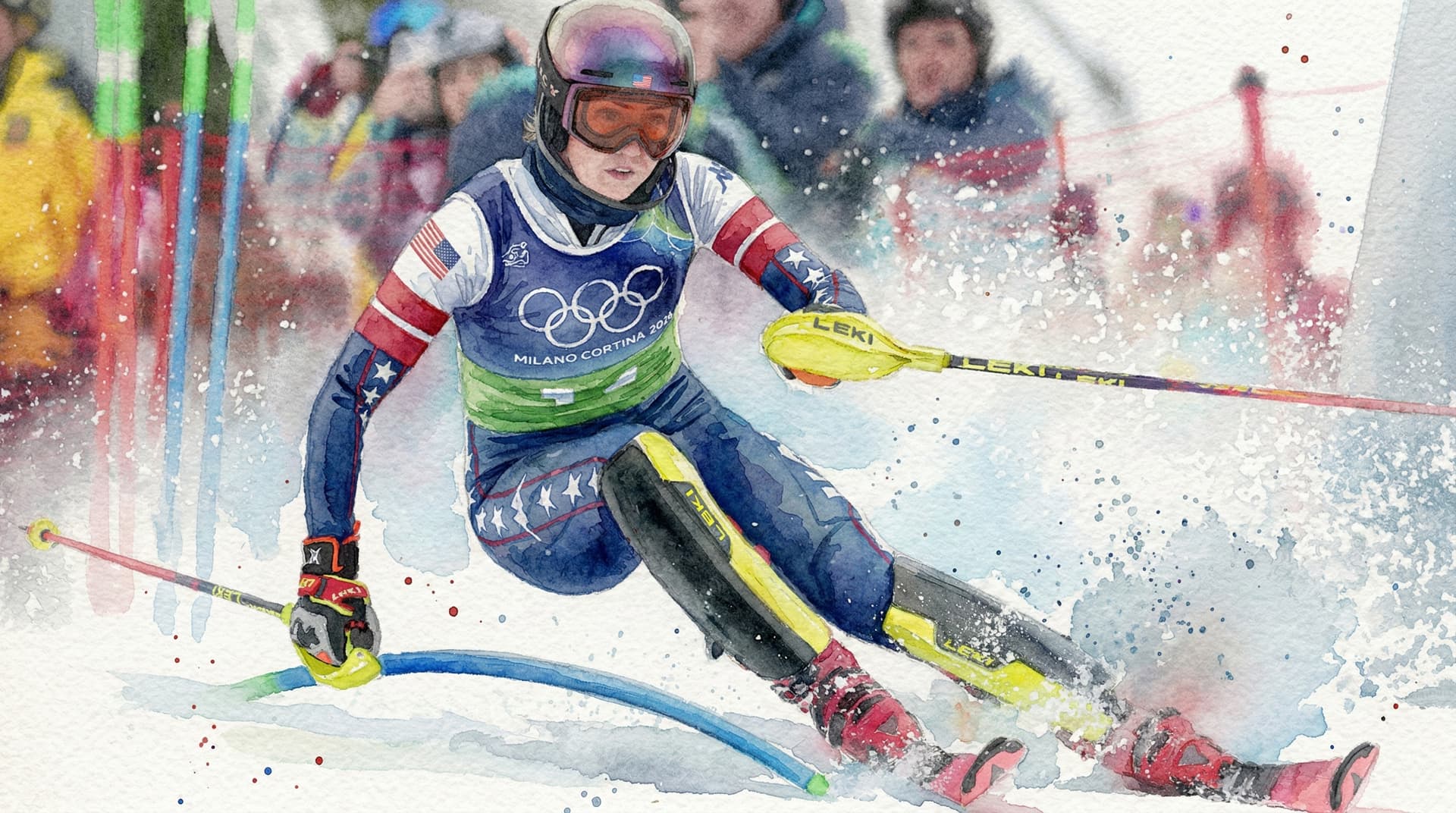
But we cannot forget the official timekeeper of the FIS Alpine Ski World Cup: Longines. The brand has seamlessly intertwined itself with ski racers, and nowhere is this more evident than on the wrist of Mikaela Shiffrin.
Shiffrin, while not racing, carves down mountains with a Longines Spirit strapped to her wrist. Thanks, Mikaela — more women should be taking notes.
And speaking of milliseconds, Shiffrin just gave us all a masterclass in what they're worth. At the Milano Cortina Olympics, after an agonizing eight-year medal drought and a string of DNFs in Beijing that she herself said made her feel “like a joke,” Shiffrin stormed to slalom gold on the slopes of Cortina d'Ampezzo. She won by a staggering 1.5 seconds, the largest margin in any Olympic alpine event since 1998. Three Olympic golds. The most ever by an American alpine skier. Longines must have been absolutely insufferable at the après-ski.
The One Timing the Whole Show
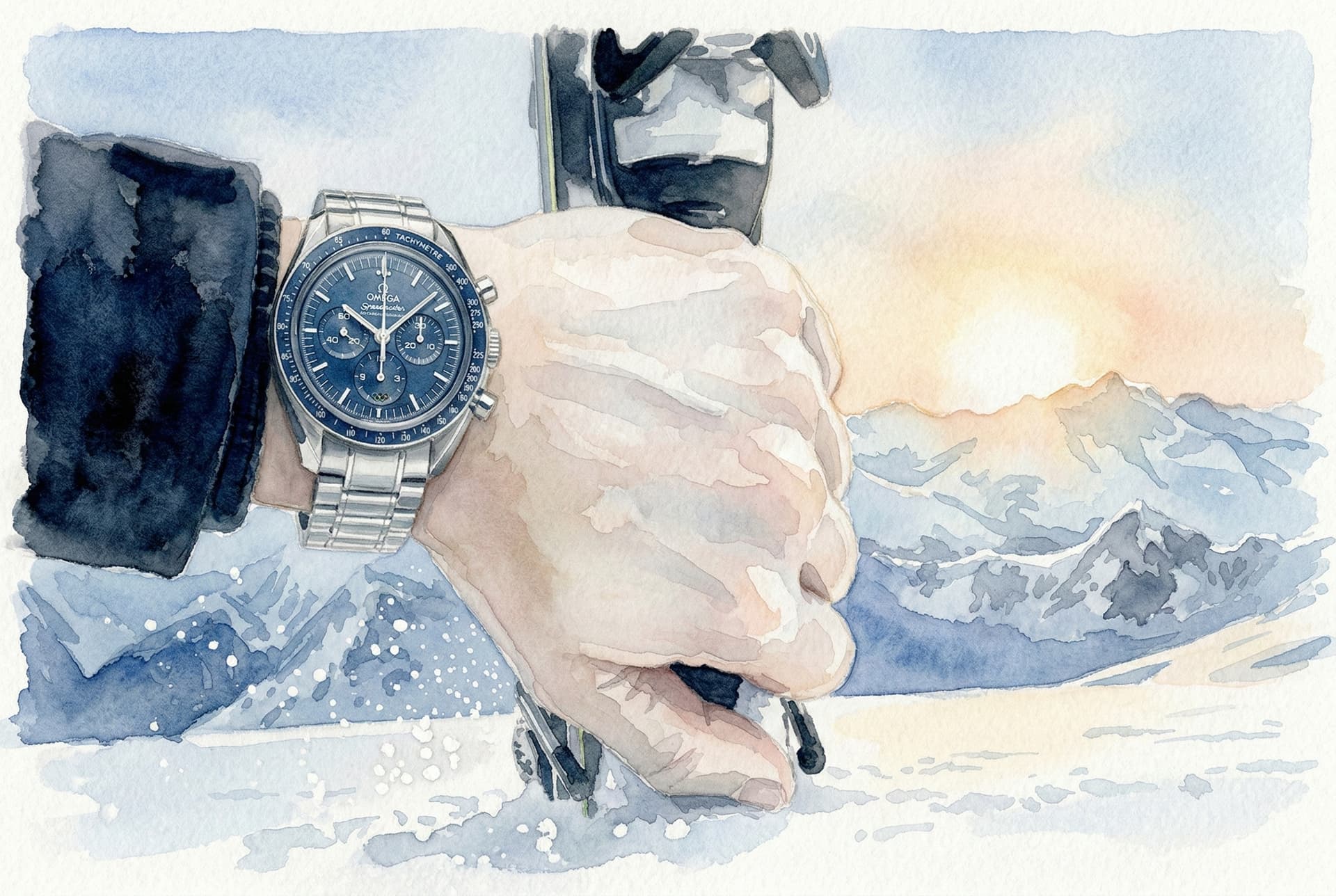
Now, Longines may time the World Cup circuit, but the Winter Olympics? That belongs to Omega. And this year, the brand marked its 32nd occasion as official Olympic timekeeper, a relationship stretching back to 1932. Ninety years of measuring the difference between immortality and a footnote.
For Milano Cortina, Omega didn't just show up with stopwatches. They opened their first-ever Winter Olympics “OMEGA House” inside Ristorante Cracco, nestled in the Galleria Vittorio Emanuele II. George Clooney was there, naturally, because what is a horological event in Milan without George Clooney?
They also released a dedicated Speedmaster 38mm for the Games, and here's where it gets genuinely charming: the subdials are finished with an azurage technique designed to resemble a freshly groomed ski slope. The dial features a frosted overlay with a finger-traced pattern inspired by the “26” of the Milano Cortina emblem. It's the kind of detail that makes watch people involuntarily reach for their wallets and ski people nod in quiet appreciation.
The Unexpected Darlings
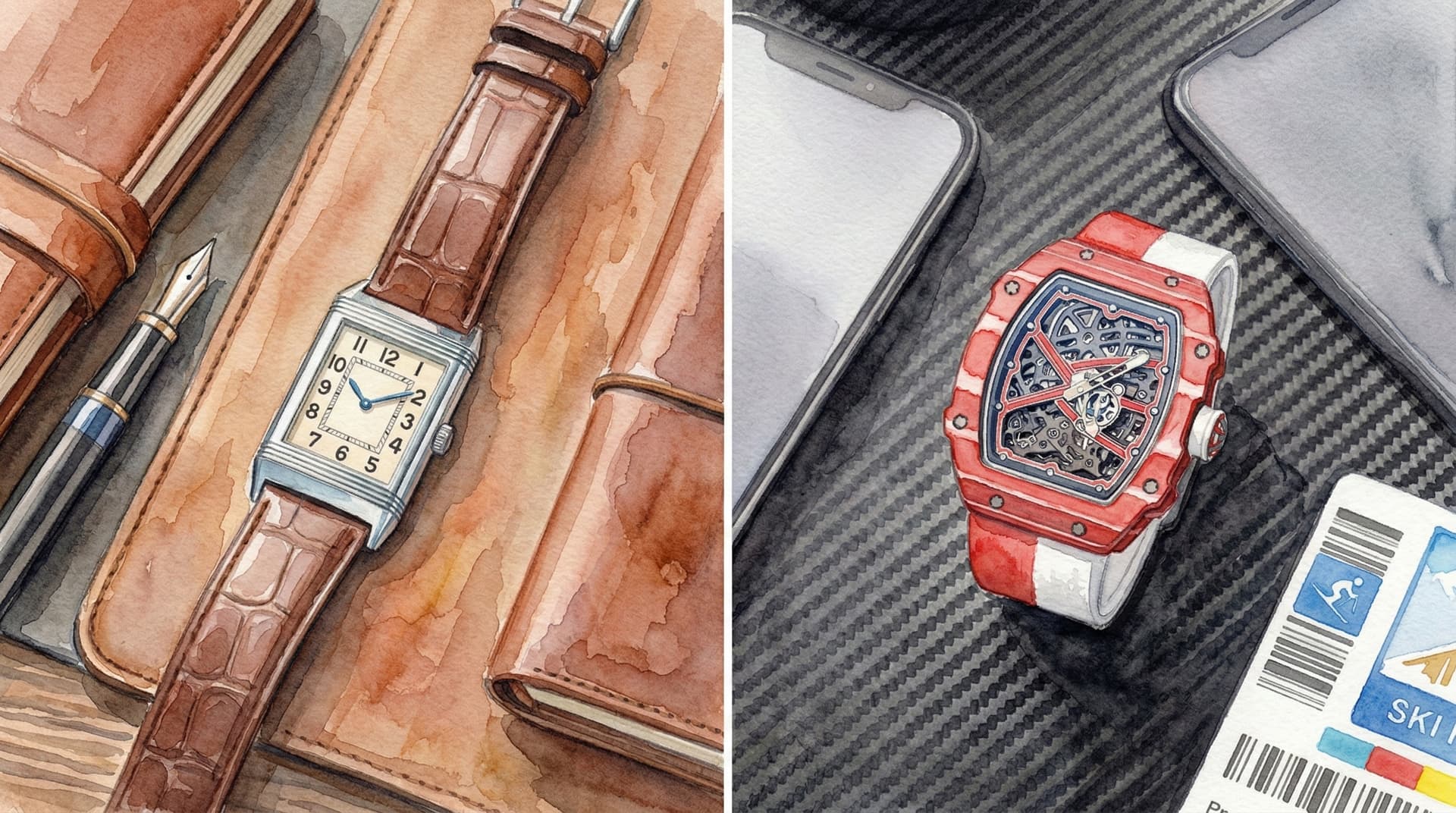
This may come as a surprise, but my next pick would be the Jaeger-LeCoultre Reverso. Originally designed for polo players in British India, it could find an unexpected following among the ski set — those who appreciate its flip-over case protecting the crystal during those inevitable off-piste tumbles.
But not everyone leans into heritage. Some prefer the cutting edge. The avant-garde Richard Mille got in on the action, creating the RM 67-02 specifically for French ski champion Alexis Pinturault. At just 32 grams, it's practically weightless.
A Final Nod
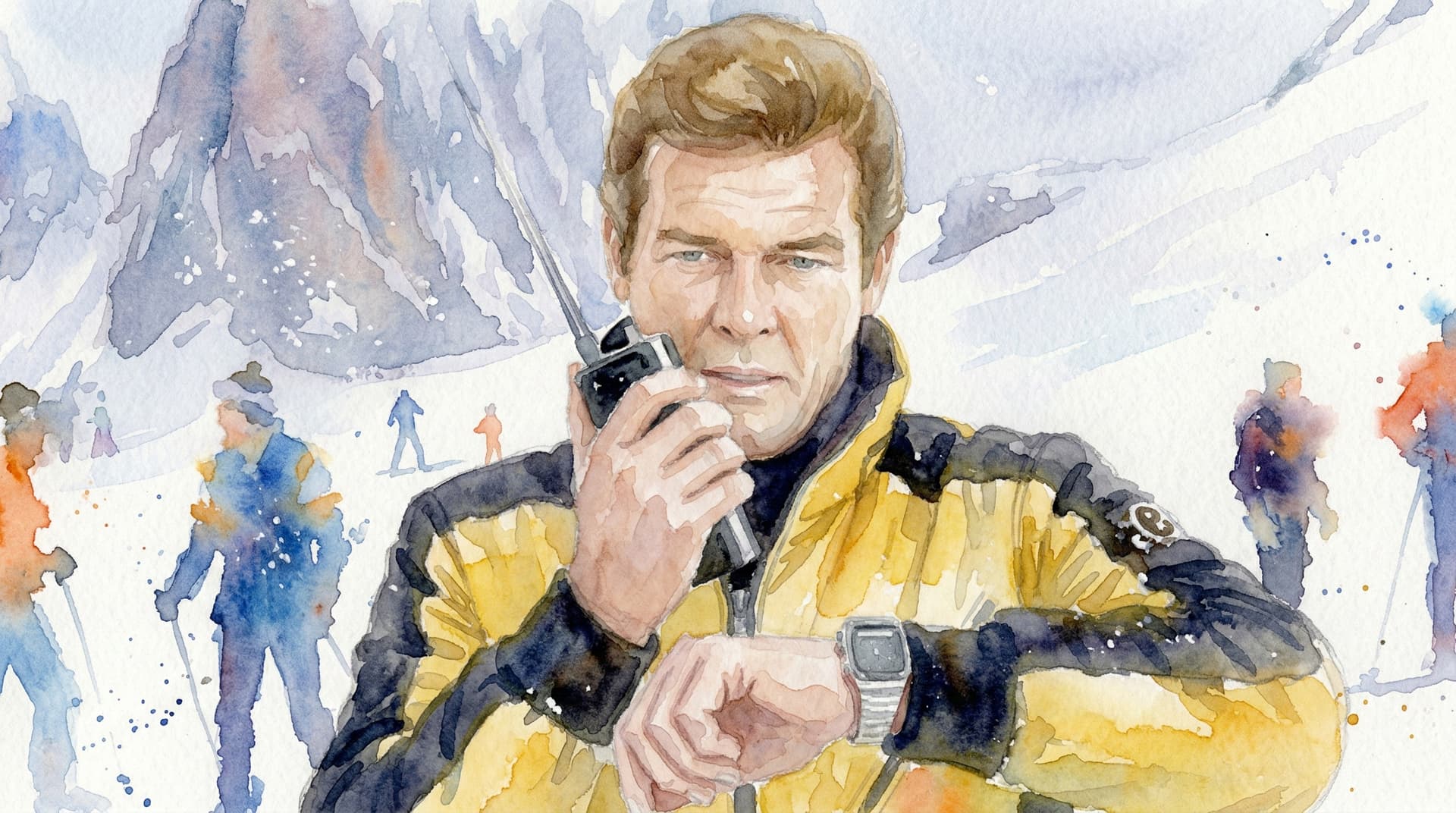
And, of course, I must mention a personal favorite: Roger Moore as James Bond in For Your Eyes Only (1981), racing down the slopes of Cortina d'Ampezzo with a Seiko H357 5040 digital quartz strapped to his wrist. But if anyone could make a Seiko look suave on the slopes, it was Moore.
And here's the thing that makes this almost too perfect. Those same slopes, that same Cortina, just hosted the 2026 Winter Olympics. Bond carved through it in '81 with a Seiko. Shiffrin conquered it in '26 with Longines measuring every hundredth of a second. Omega timed the whole affair from a palazzo in Milan while Clooney sipped something expensive. Forty-five years apart, the same mountains, and the watches were always part of the story.
So where does this leave us? Somewhere between the summit and the base lodge, I suppose, with cold air biting at our cheeks and the faint click of a mechanical movement ticking away beneath our gloves. I'm not going to pretend that wearing a proper watch while skiing will make you a better skier. It won't. You'll still catch an edge on that same patch of ice you always catch an edge on. But you'll do it with style. And in my humble, entirely biased opinion, that counts for something.
After all, nobody ever looked back on a perfect powder day and thought, “I really wish I'd tracked my VO2 max.”